Can a bus stop make you want to miss your bus?
What if the original social network went social in real life?
Yahoo brought millions of people together online. We wondered whether it could do the same thing in the real world. Back in 2010, when digital was increasingly becoming synonymous with social, we wanted to explore a rather different possibility: using technology to make complete strangers connect, face to face.
And where better to start than a place where people stand next to each other every day, pretending nobody else exists?
Turning strangers into neighbours.
San Francisco has always had fiercely proud neighbourhoods. We decided to put that local rivalry to good use. We transformed 20 bus shelters across the city into connected multiplayer gaming stations, complete with enormous interactive touchscreens. People waiting at one stop could compete live against people at another, earning points for their respective neighbourhoods in a citywide battle for bragging rights.
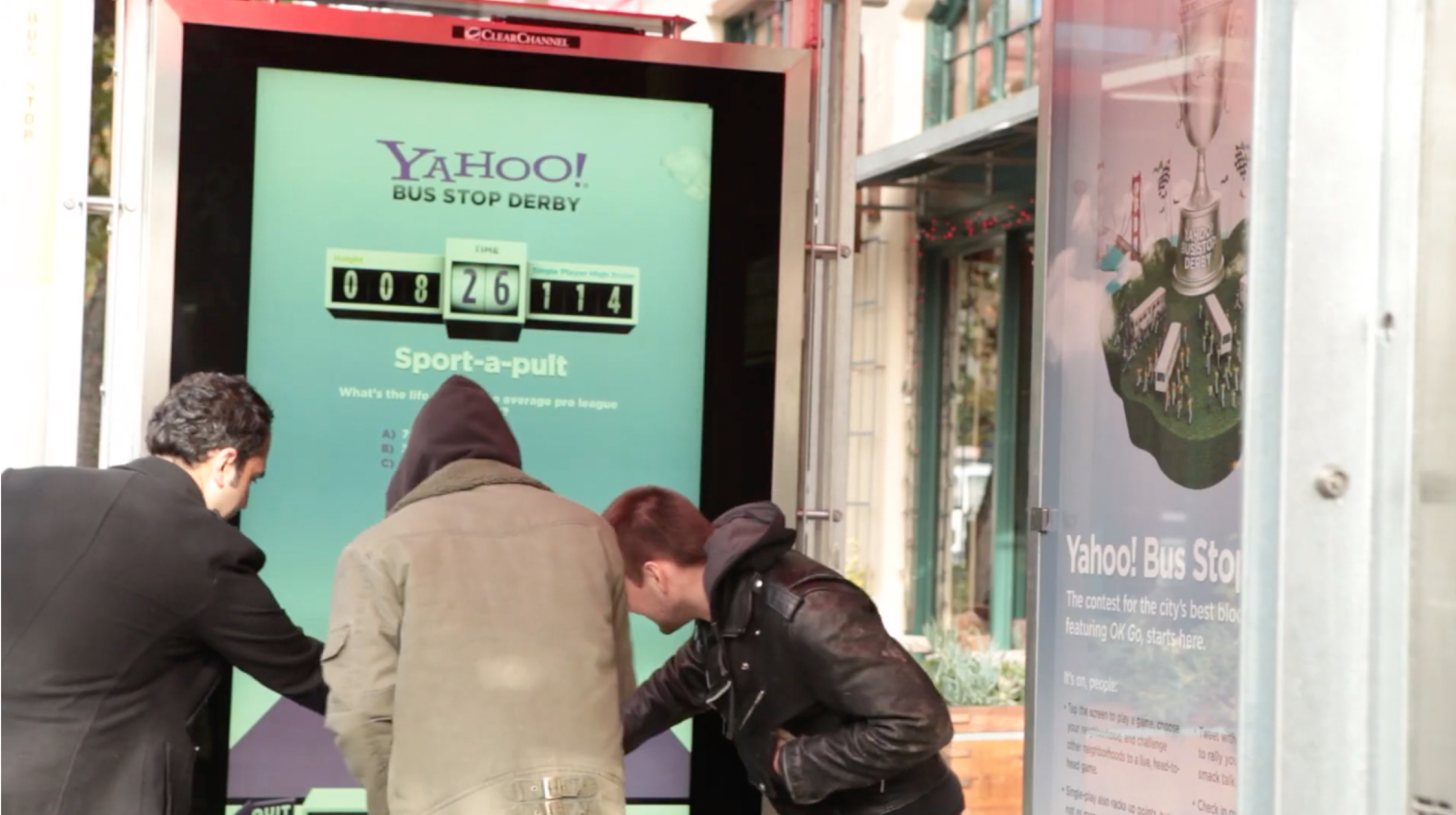
The prize? A neighbourhood block party featuring OK Go.
Suddenly, strangers became teammates, bus stops became unlikely community hubs, and the daily commute became something people actually looked forward to.
And then everybody showed up.
Over nine weeks, people played more than 150,000 games, spending a combined 2,000 hours at our bus stops. Some even missed their buses because they were too busy playing. Others turned up to play even when they had absolutely nowhere to go. North Beach eventually emerged victorious, earning a neighbourhood block party featuring OK Go. What started with strangers competing through screens ended with a neighbourhood celebrating together in the streets. Not bad for an internet company trying to bring people together.
Project created and developed at Goodby Silverstein & Partners for Yahoo, 2010–2011.

We’d love to hear from you:
hello x weareopen x fi
firstname x weareopen x fi
© we are open Ltd. 2026.
